Showing posts with label local movement. Show all posts

Sunday, November 13, 2011

Starting Sourdough Starter


At the begining of the year, I made it a quest to become a domestic goddess which including making a killer loaf of bread.  So that hasn't happened yet and this morning I woke up deciding to start my own sourdough starter.  Which by the way, is super easy and I can't believe I haven't done things before; it's just the whole feeding it everyday thing I need to remember. 

I remember the first time I heard of sourdough starter I was kinda grossed out.  Years ago, I saw a story about a bakery in San Fransisco that makes their bread from a starter dating back to the 19th century or earlier 20th century. Admittingly, I had no idea what went into making a sourdough starter and this was pre-eating bacteria is good for you phase of my life.  The chance of that San Fransico's starter still having flour that was over 100 years old is pretty slim and later, after learning what a starter was I was less grossed out. 

Sourdough starter is the tratitional way of leavening bread; how our ancestors made bread before they could go to the store and pick up some Fleshmanns. When the mix is left on your contertop, wild yeasts are cultivated in the container.  How in the world does that happen?  Well, when the flour and water become one in your container, it starts to ferment yeast which creats lacto bacteria which feed on metabolic products produced by the yeast, while producing lactic acid preventing unwanted organisms from infecting your starter (The Urban Homestead).  Whew!  Alton Brown explains it much better, don't you just love his videos?

Sourdough bread is reported to be "richer in certain vitamins and enzymes that are by-products of lactic fermentation, and it contains less phytic acid, which blocks mineral absorptoion." (Good Bread is Back). A perfect loaf of sourdough bread has a crispy crust and soft, chewy, tender inside.  Delish if you ask me. 

To make your starter:

1. Get a glass container with a lid that can hold at least 4 cups of liquid.
2. Add 1 cup white flour & 1 cup lukewarm water (I used unbleached, organic flour from a local mill).
3. Stir until smooth.
4. Put lid on the jar and place it in a warm place to rest.  I am keeping mine on top of my stove. 
5. Everyday pour off 1 cup of starter and add 1/2 cup of flour, 1/2 cup warm water. YOU MUST FEED IT EVER DAY!
6. After a few days it will start to get bubbly, this is good and a layer of liquid forms on top. 
7. After two weeks, you shoud have active culture of wild yeasts that you can bake bread with. 

You can use the cup of starter that you throw out every day to make pancakes, muffins, etc... Which I intend on doing, so it doesn't go to waste!

I will keep you updated on the progress of my yeast!

Sunday, May 22, 2011

The things you miss when you're not looking

I have lived in my current apartment for 3 years and just noticed not one, but two mulberry trees near me.  And one is in the back of my building! This has me thinking of how much other amazing finds I am missing because I am just not paying attention.  The other day I was walking my dog and we went to this part we always go to and Sadie decided to pee under this tree, I looked up and noticed berries resembling blackberries.  They weren't blackberries but mulberries; all ripe and delish.  Then today, again walking Sadie, I noticed another tree as she was doing her business. 

So of course I will be picking mulberries and making some jam and muffins and whatever else I can come up with.  I plan on freezing what I don't use, so I guess I need to pick a lot.  I am also thinking I need to go ahead and buy one of those vacuum sealers because I also got a plot in a community garden that is huge, so I will be growing a lot more than what I thought. 

I decided to eat a few mulberries today and I had the darnedest time getting those stems off the berry.  I just ate them, but surely there is an easy way to remove them. 

Do you have a favorite mulberry recipe?

Tuesday, February 22, 2011

I am an urban homesteader!

In my recent quest to become a domestic goddess, I have been reading a lot of blogs about urban homesteading: having a farm in the city basically.  Today when reading Root Simple , a blog written  by Kelly Coyne and Erik Knutzen (they wrote the book The Urban Homestead: Your Guide to Self-Sufficient Living in the Heart of the City), I discovered while I'd been living in my Pure Romance bubble, a war is breaking out in the urban homestead movment.

A family in Pasedena, CA, the Dervaes, have recently sent out a letter to bloggers, libraries, publishers, authors etc.... saying the term urban homestead cannot be used for because they own the trademark  (along with several other phrases/words) to please reference appropriately so legal action is not taken. As a result there is a huge movement to support the urban homestead movement and to get the trademark decision reversed (not sure if that is possible).

What? Really? The phrase urban homestead is trademarked?  The idea is ludricis to me.  When I hear urban homestead, I think of it as a lifestyle.  Wanting to support local businesses.  Wanting to be more self sustainable, eating seasonally, knowing where your food comes from, all while living in a community instead of in the middle of a 100 acre farm. How can you trademark that? Well last year the application for trademark was approved for the Dervaes. 

Oxford dictionary defines homestead as:
1 a house, especially a farmhouse, and outbuildings.
2 Law a person‘s or family’s residence, which comprises the land, house, and outbuildings, and in most states is exempt from forced sale for collection of debt. 
So, by exact definition an urban homestead is a house in an urban area, and they want to trademark this?


The word homestead, historically is not pretty.  In 1862, the US goverment passed the Federal Homestead Act granting 160 acres of land to anyone who wanted to farm it.  Many of you remember that movie with Nicole Kidman & Tom Cruise, Far & Away, they go out west to claim their land.  The Homestead Act was revised several times and one could claim federal land and receive the deed well into the 20th century (although it was much more popular at the end of the 19th century)

I hold a degree in history and I will be one of the first to tell you, the  US government was giving away land that was not "theirs".  The whites in charge took the land away from the Native American nations either by killing them or removing them by force. Much of the history of the United States is not pretty and is not fair, this country was built by breaking the backs of others (but that's a whole other blog), we  should learn our history, then move on and learn not to repeat it.   I don't believe the majority of people who consider themselves urban homesteaders are reliving glory days of killing non-whites.

Ten Apple Farm put a great statement in their post, "Whatever you want to call what you do, in whatever setting you are doing it, as homesteaders we are all connected by a conscious choice to live closer to the land.  We choose to tend animals, to grow, gather and preserve our gardens, and to combine self-sufficiency with a spirit of community. You can’t put a trademark on that."

The Dervaes family is claiming they have the right to the term urban homestead because it constitutes intellectual property.  I am not a lawyer and do not understand most law, but I know the Devares family were not the first to a garden in their backyard in the city.  

To learn more here are some great blogs on the issue:

EFF  - legal support for Kelly Coyne & Erik Knutzen
Farm Curious
FB page Take back Urban-Homesteading

Wednesday, January 19, 2011

Adventures of a first time canner

About 10 years ago, I decided to cut back on the amout of eat I was eating after I became educated on how much energy went into bring that chicken or that pork to my table.  I started buying meat  from local farmers, but if you live in NYC then you know how expense shopping at the Union Square Farmers Market can be.  When I moved from NYC to Louisville, I had joined Americorps and was completely broke, so buying organic meat from local farmers was out of the question, so I stopped eating meat. 

In recent years, I have started embracing the local movement: buying from local stores, artists, eating at local restaurants, and of course farmer's markets (I never stopped buying my veggies from  them).   I have the secret dream to homestead: raise chickens, have sheep, spend my days making pie, running through fields of wildflowers, and sewing; in Maine, I want all this to happen in Maine.

This past winter as the last of the farmers sold their squashes and I went to the grocery store, I was depressed at the state of my choices in "fresh" produce.  I don't know why the sad state of the lettuce and tomatoes didn't affect me as much in previous years, but this year I was in horror  of the produce they were selling. 

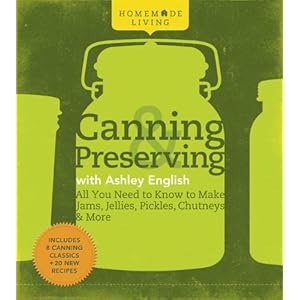
I decided several weeks ago I wanted to start canning and preserving my delish veggies this summer and wanted to practice before the first harvest.  I'd been researching books and decided to purchase "Canning & Preserving" by Ashley English.  I love how pretty the pages are to look at, I am a stickler for pictures in any sort of book that has to do with food.  If there are not pictures, I am not interested in   to cook from it.  This book is not only loaded with pictures, but it's easy to follow.  Ashley makes canning sound so easy that even I could do it.  I told a friend today I had decided to start canning, and he asked what had I made so far.  Despite my enthusiam for wanting to can, I haven't actually done it yet; I am trying to take the sensible approach and read everything before I dive in, elimiating a huge screw up. I've heard a lot of tales about how if you can something the wrong way you can get poisoned, which just confuses me because our grandmothers canned all the time.  So, I would like to find out, how exactly could I get poisoned, do you know?

Do you can? I'd love to hear your feedback, do you find it enjoyable?

Stay tuned for more adventures in canning!